Embedded Systems
Skill Programs
/
ECE-EEE Programs
Embedded Systems
“Design, build, and program intelligent hardware systems that power the modern world with our all-in-one Embedded Systems program.”
Gain a strong foundation in microcontrollers, embedded C programming, IoT integration, sensors, and real-time operating systems — all while working on hands-on electronics projects. With practical labs, expert guidance, and hardware simulation tools, you’ll learn how to design, code, and optimize embedded devices used in automation, robotics, automotive, and smart technologies.
Technologies You’ll Learn


Our Approach
At our EdTech-powered learning hub, we follow a hands-on, innovation-driven, and project-based approach to Embedded Systems — ensuring every student gains real hardware experience, learns to code efficiently, and understands the complete system design cycle from concept to deployment.
Discovery & Research
Understand the fundamentals of embedded systems, microcontrollers, and real-time computing.
Analyze real-world embedded applications in automotive, robotics, and IoT.
Learn how hardware and software integrate to create efficient systems.
Hardware & System Design
Learn circuit design, sensor interfacing, and microcontroller architecture.
Work with tools like Proteus, EasyEDA, and Arduino IDE.
Design and simulate embedded circuits for real-world functionality.
Programming & IoT Integration
Develop programming skills in Embedded C, Python, and C++.
Work with platforms like Arduino, Raspberry Pi, and ARM Cortex.
Integrate IoT features using ESP32, MQTT, and cloud services (AWS, ThingSpeak).
Testing & Optimization
Learn to debug, test, and optimize embedded code and circuits.
Use professional tools like Keil µVision and logic analyzers.
Optimize systems for speed, power efficiency, and reliability.
Build and present a final embedded project showcasing full development workflow.
Join the Program




Certifications
Professional achievements and credentials
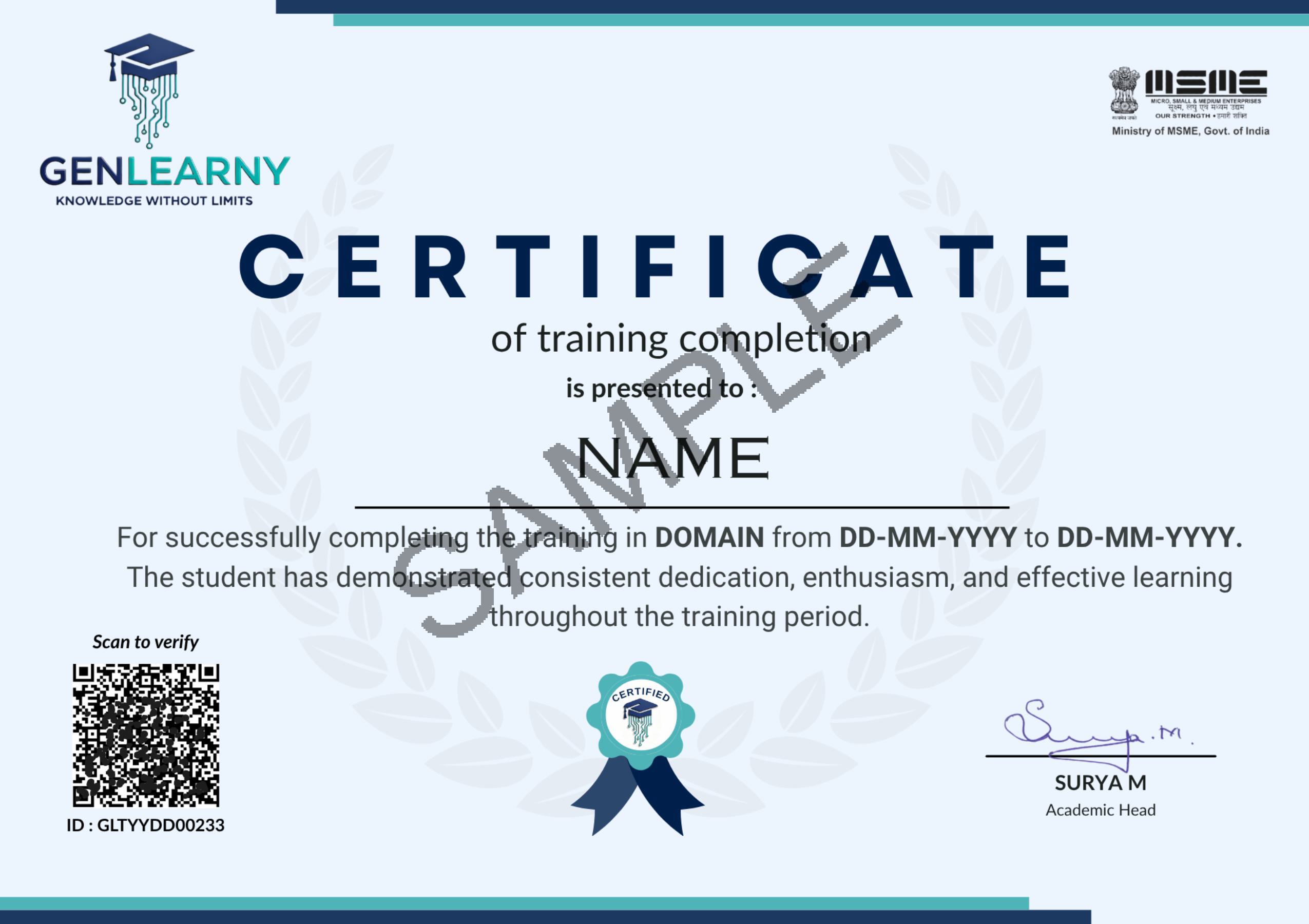
Training Completion Certificate
Issued by GenLearny
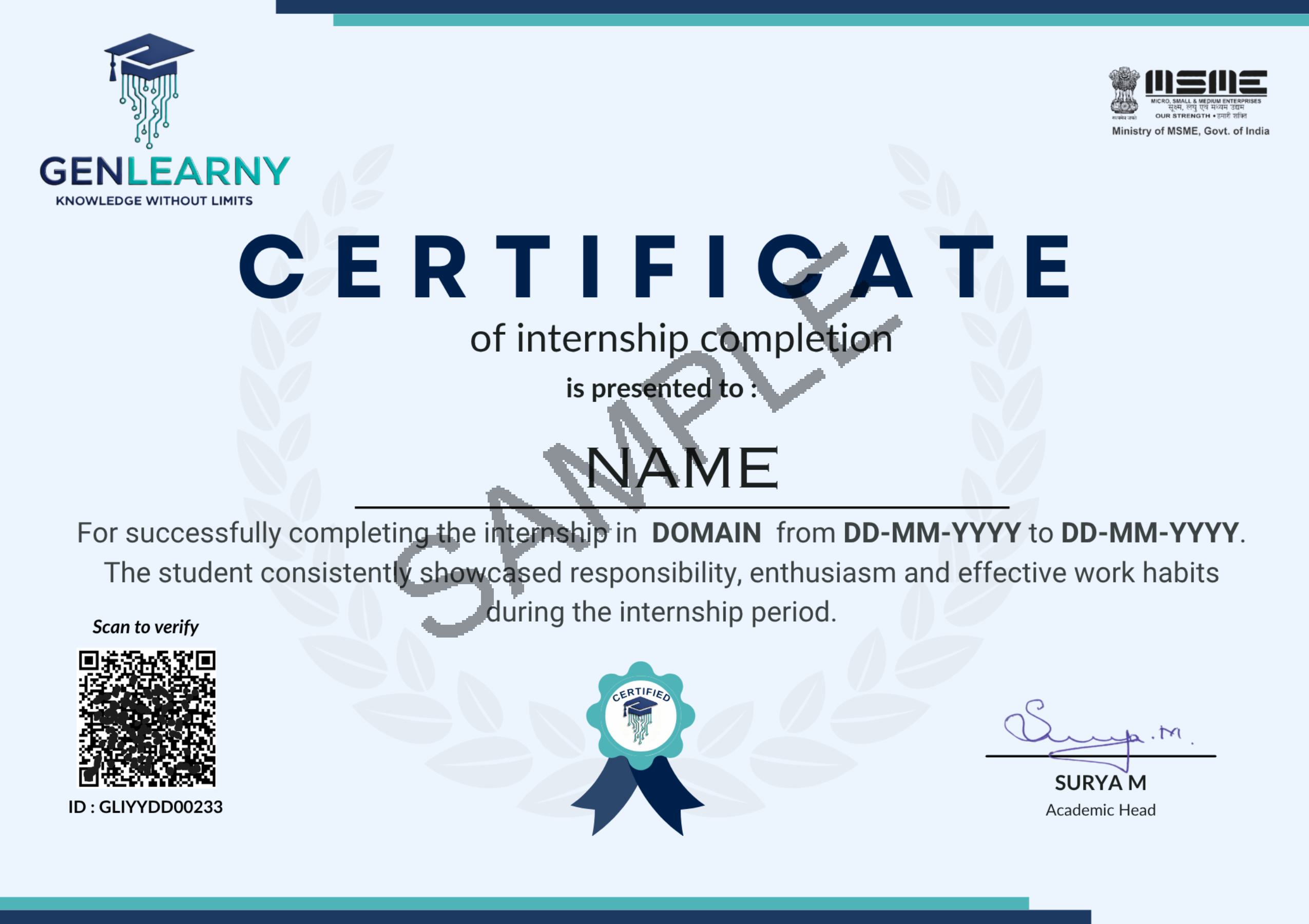
Internship Completion Certificate
Issued by GenLearny
Companies Hiring Embedded Systems Engineers










Program Curriculum
Definition and characteristics of embedded systems.
Real-world examples: automotive, healthcare, consumer electronics, industrial automation.
Components overview: microcontrollers, sensors, actuators, and embedded software.
System design flow: specification → design → development → testing.
Practical : Identify and understand the components of a development board (Arduino/STM32).
Difference between microprocessor and microcontroller.
Internal architecture: CPU, memory, timers, interrupts, and I/O ports.
Overview of popular controllers: 8051, AVR, PIC, ARM Cortex, Arduino, Raspberry Pi.
Memory organization and addressing modes.
Practical : Explore pin configuration and register structure of a microcontroller.
C language basics for embedded systems.
Data types, operators, control statements, and functions.
Embedded-specific concepts: bitwise operations, volatile variables, pointers.
Understanding compilers, assemblers, and linkers.
Practical : Write simple C programs (LED control, delay generation).
Digital input/output concepts.
ADC (Analog-to-Digital Conversion) and DAC (Digital-to-Analog Conversion).
Interfacing sensors (temperature, LDR) and actuators (motors, relays).
PWM and signal generation.
Practical : Interface a sensor and visualize analog data.
Introduction to serial communication.
UART, SPI, and I2C — architecture, working, and use cases.
RS232, USB, and CAN Bus basics.
Synchronization, data framing, and baud rate concepts.
Practical : Implement serial communication between two devices.
Overview of memory types: ROM, RAM, Flash, EEPROM.
Interfacing external memory and data logging.
Data storage techniques and memory optimization in firmware.
Practical : Store sensor readings into EEPROM (theory + simulation).
What makes a system “real-time.”
Types: Hard, Soft, and Firm RTOS.
Task scheduling, priority, interrupts, and synchronization.
Introduction to FreeRTOS and its architecture.
Practical : Simulate task scheduling using pseudo-code examples.
Schematic design and PCB basics.
Power supply design, regulators, and circuit protection.
Introduction to simulation tools: Proteus, Multisim, EasyEDA.
Testing and debugging techniques using oscilloscopes and multimeters.
Practical : Design a simple circuit schematic in Proteus.
Introduction to Internet of Things (IoT).
IoT architecture and communication layers (sensors → microcontroller → cloud).
Networking modules: Wi-Fi (ESP8266, ESP32), Bluetooth (HC-05).
Cloud platforms: ThingSpeak, Blynk overview.
Practical : Send a sensor value to a cloud dashboard (theory + demo).
Embedded systems in automotive, defense, healthcare, and smart devices.
Firmware development life cycle (FDLC).
Version control (Git overview), testing, and documentation.
Career paths: Embedded Developer, IoT Engineer, Firmware Engineer, PCB Designer.
Practical : Group discussion on real-world embedded system use cases.
Affordable and Student-Friendly Pricing

Gen-Edge
₹5,000
- Recorded Lectures
- Real Time Projects
- Live Sessions
- One On One Doubt Clearing Sessions
- Certifications
- Mentor Support
- Placement Guidance
- Interview Assistance
- LinkedIn Optimization

Gen-Pro
₹9,000
- Recorded Lectures
- Real Time Projects
- Live Sessions
- One On One Doubt Clearing Sessions
- Certifications
- Mentor Support
- Placement Guidance
- Interview Assistance
- LinkedIn Optimization
# FAQs
Answers to Your Most Common Questions


We provide internship programs across CSE/IT, Management, ECE/EEE, Mechanical Engineering, and Digital Marketing, focusing on real-world projects and skill development.
Yes! Our internship programs are designed to accommodate beginners while also challenging advanced learners with hands-on tasks.
Yes, all our internship programs are designed in collaboration with industry requirements to provide practical, real-world experience.
Students, fresh graduates, and anyone looking to gain hands-on industry experience can apply, regardless of their prior knowledge.
You gain practical experience, work on real-time projects, build a strong portfolio, and improve employability in your chosen field.
Yes. Every participant is guided by industry professionals to ensure a meaningful learning experience.